Showing posts with label Rides. Show all posts

Friday, 24 November 2006

Spade Roller

Spade Roller


This picture will be the last series taken from the Royal Melbourne Show 2006. This is another puke producing machine which will spins you 360 degrees with a up and down motion. There is a total of 3 section supported by the arms.
Thursday, 23 November 2006

Cliff Hanger

Cliff Hanger


This picture was taken during the Royal Melbourne Show 2006. People sit on it and this machine will spin you 360 degrees vertical and horizontally. An excellent puke-producing machine. The light bulbs on its arms produce a smooth circular trail of light as it spins. A tripod is needed to produce this kind of picture as a few second exposure is needed and it's not possible to do it handheld without blurring the image.


On 17 January 2004, there was a cliff hanger incident that occurred in Florida. It caused Florida to close all Cliff Hanger Rides until investigation is finished on the structural failure on one of its cliff hanger.

(courtesy rideaccidents.com)

Wednesday, 22 November 2006

Helical Delirium

Helical Delirium


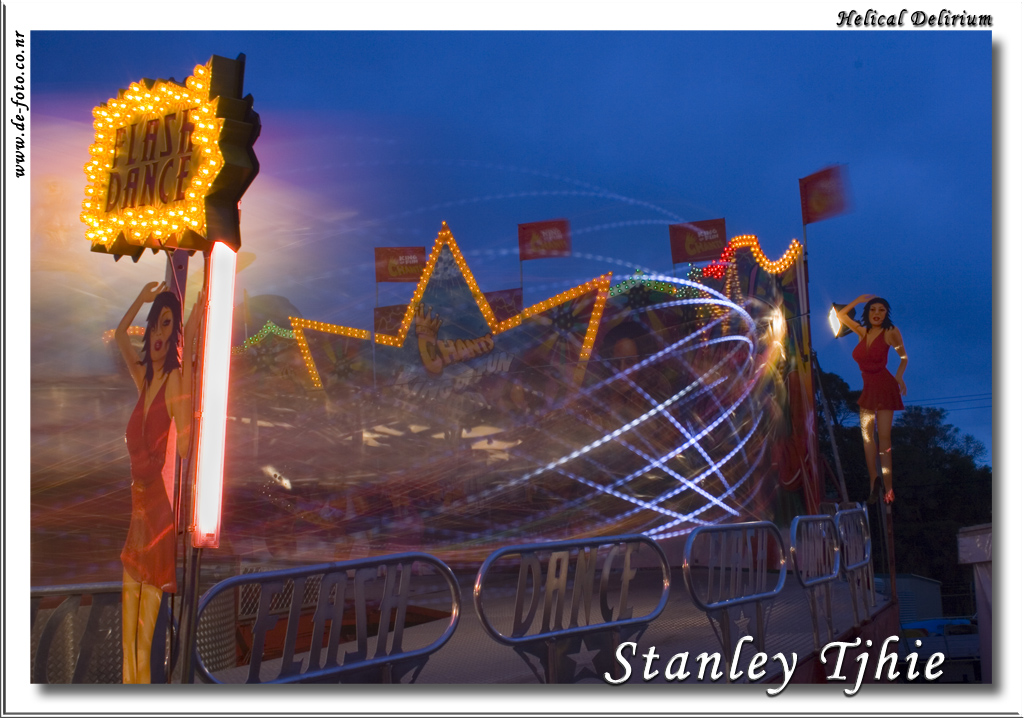
This photo was again taken at the Royal Melbourne Show 2006. One of the ride was this crazy free turning mobile which will turn in the forward direction and the backward direction too. Plus all the lateral movement. Whatever it was, this ride was scary. This picture was taken at dusk when the sky is not too dark but the optimum dark bluish colour. The discovery of this pattern of light streaks is quite accidental when I had wanted to take the full ride picture with slow shutter speed and noticed the side has these light streaks. I decide move myself and focus on that area. Therefore, it is important to take a while to review the picture you have taken to see if everything is OK and what you really wanted. This picture reminds me of bobsleight due to the almost vertical and bent surface of the "virtual" track.


Bobsleigh is a winter sport in which teams make timed runs down narrow, twisting, banked, iced tracks in a gravity-powered sled. In the United States and Canada the sport is known as bobsled.

The sport of bobsleigh was invented in Switzerland. The first races were run on snow-covered roads, with the opening competition in 1884 at St. Moritz. The first club was formed in 1897, and the first purpose-built track was opened in 1902.

The Fédération Internationale de Bobsleigh et de Tobogganing (FIBT) was founded in 1923. Men's four-crew bobsleigh appeared in the first ever Winter Olympic Games in 1924, and men's two-crew bobsleigh was added in 1932. Bobsleigh was not included in the 1960 Winter Olympics, but has been in every Winter Olympics since. Women's bobsleigh started in competition in the early 1990s, and women's two-crew bobsleigh made its Olympic debut at the 2002 Winter Olympic Games. Bobsleigh is also contested at World, European, and World Cup championships.

Switzerland and Germany have been the most successful bobsleighing nations over European, World, World Cup, and Olympic championships. The Swiss have won more medals than any other nation, and since the 1990s Germans have been dominant in international competition. Italy, Austria and Canada also have strong bobsleigh traditions.

Ideally, a modern track should be 1200 to 1300 metres long and have at least fifteen curves. Speeds may exceed 130 km/h, and some curves can subject the crews to as much as 5 g.

Modern sleighs combine light metals, steel runners, and an aerodynamic composite body. Competition sleighs must be a maximum of 3.80 m long (4-crew) or 2.70 m long (2-crew). The runners on both are set at 0.67 m gauge. Until the weight-limit rule was added in 1952, bobsleigh crews tended to be very heavy. Now, the maximum weight, including crew, is 630 kg (4-crew), 390 kg (men's 2-crew), or 340 kg (women's 2-crew). Metal weights may be added to reach these limits, as greater weight makes for a faster run.

Bobsleigh crews once consisted of five or six people; they were reduced to two- and four-person sleighs in the 1930s. A crew is made up of a pilot, a brakeman, and, in 4-crew only, two pushers. Athletes are selected based on speed and strength, necessary to push the sleigh to a competitive initial speed at the start of the race. Pilots must have the skill, timing and finesse to drive the sleigh along the best possible line to achieve the greatest possible speed.

Women compete in two-crew events, and men in both two- and four-crew competition.


Runs (lauf) begin from a standing start, with the crew pushing the sled for up to fifty metres before boarding. The runners of the sled follow grooves in the ice for this distance, so steering is unnecessary until after the sleigh exits the starting area. Races can be lost in the initial push but are rarely won there. Over the rest of the course, the sleigh's speed depends on its weight, aerodynamics, and runners; the condition of the ice; and the skill of the driver.

Race times are measured in hundredths of seconds, so any error can have a significant impact on the final race standings. Even small errors make for small decreases in speed and commensurate increases in time. Because any decrease in speed affects the sleigh for the remainder of the course, errors made high on the track will have a greater effect than those made closer to the finish.

The men's and women's standing are calculated over the aggregate of two runs. At the Olympic Winter Games and World Championships, all competitions (for either men or women) consist of 4 heats.

(courtesy wikipedia.com)
Tuesday, 3 October 2006

No Imi

No Imi


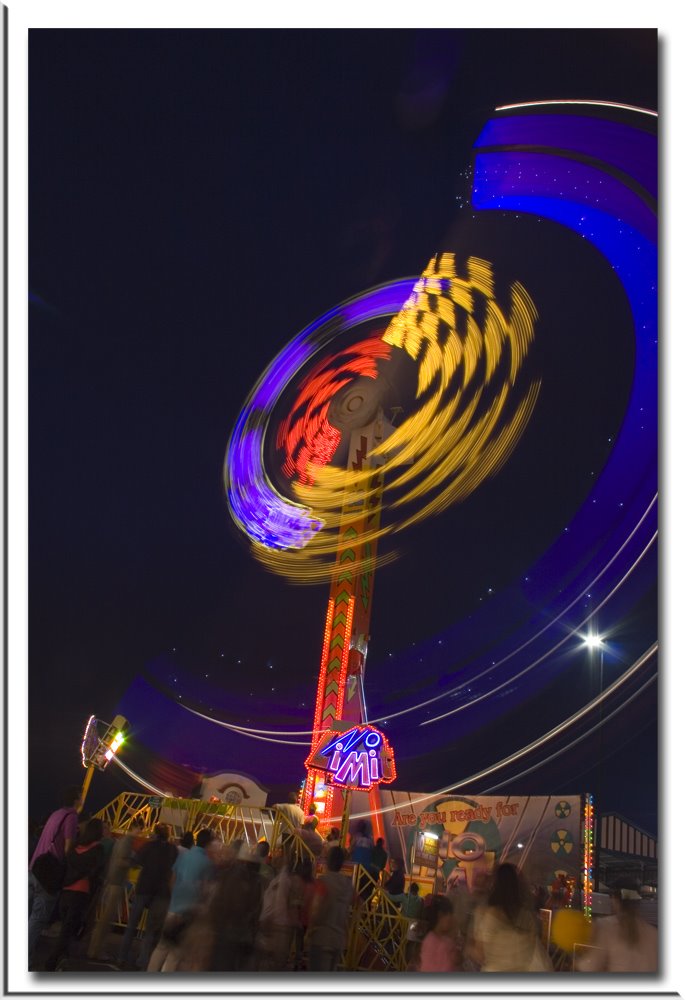
For a change of colours from the sandy brown, blue sky and the black and white yesterday, I am jumping through my photo to my recent visit to the Royal Melbourne Show 2006. It was a great place with the damn hot sun hanging high and showers approaching the night. The colours were great. I told myself that I should have went there earlier as 1st October was the last day. This featured ride inmy blog is called No Imi. A 360 degrees turn ride with some hanging in the air still moments. Of course I didn't ride it or else the people bellow better start opening their umbrellas. This ride was powered by a fan. Yes, a FAN! a gigantic fan fixed to main arm. It is able to stop the ride in the mid air and turn it the make it swing the other way round!


There are three main types of fans used for moving air, axial, centrifugal (also called radial) and cross flow (also called tangential). The axial-flow fans have blades that force air to move parallel to the shaft about which the blades rotate. Axial fans blow air across the axis of the fan, linearly, hence their name. This is the most commonly used type of fan, and is used in a wide variety of applications, ranging from small cooling fans for electronics to the giant fans used in wind tunnels. The centrifugal fan has a moving component (called an impeller) that consists of a central shaft about which a set of blades form a spiral pattern.

Fans typically go along together with electric motors. An electric motor's poor low speed torque and powerful high speed torque are a natural match for a fan's load. Fans are often attached directly to the motor's output, with no need for gears or belts. The electric motor is either hidden in the fan's center hub or extends behind it. For big industrial fans, 3-phase asynchronous motors are commonly used.

(courtesy wikipedia.com)

Sunday, 23 April 2006

Yoo Hoo!!!

Yoo Hoo!!!
Gold Coast Movieworld Roller Coaster